Body tattoo removal
Book an appointment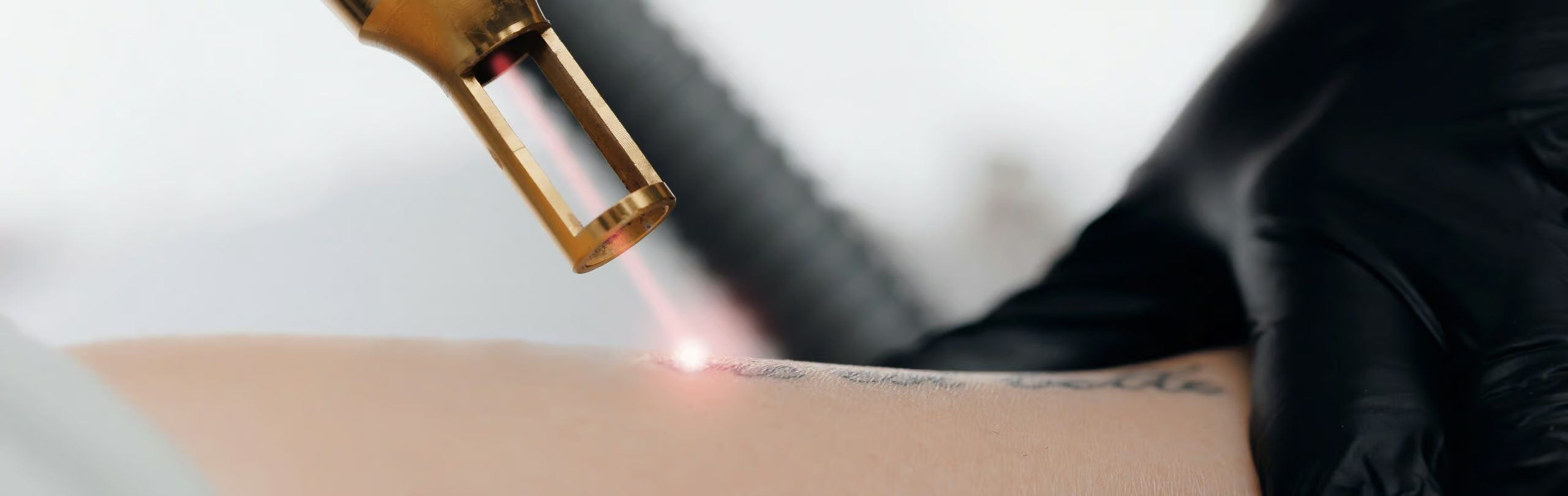
Although a tattoo is still considered a permanent mark, innovations in aesthetic medicine have led to treatments that can remove it. Men and women alike, of all skin tones and on any part of the body, can have their tattoo removed.
Discover the treatments offered in our tattoo removal centres in Nice and Neuilly-sur-Seine. Our picosecond lasers are the best solutions available to get rid of a tattoo quickly and painlessly.
Tattoo removal: what is it?
A tattoo is a decorative or symbolic design on the skin. Tattoos are particularly sought after for being permanent and lasting.
Traditionally, tattoos were applied to the skin using Indian ink, charcoal or even tallow. Today, tattoo artists mostly use industrial pigments. This coloured pigment is inserted into the skin between the epidermis and the dermis with a needle. The ink sits deep enough in the skin, around 1 to 4 millimetres, to remain permanent.
Sometimes people no longer want a tattoo, or the design has deteriorated over the years (blurring, distortion, etc.). Thanks to aesthetic medicine, a tattoo can now be removed almost permanently.
When should you have a tattoo removed?
Some tattoos are poorly done or age badly over time. In that case, the lines stretch and the ink spreads slightly. A poorly done tattoo can also fade and lose its colour. The result? A tattoo that is not very attractive and barely resembles the original design.
The tattooed person has two options: a cover-up at the tattoo artist’s, meaning covering it with another tattoo, or laser tattoo removal sessions in a specialist centre.
Cover-ups are not always possible on a poorly done tattoo. It may be too dark or too damaged to be covered by another design, and the first tattoo sometimes remains visible underneath. Note that a cover-up means getting a new tattoo that is bigger than the old one, which is not to everyone’s taste. What is more, doing a cover-up without any prior removal sessions considerably limits the choice of new design. That is why a few laser removal sessions before a cover-up give more options to anyone wanting their tattoo covered.
Finally, the tattooed person may no longer want any tattoo at all, because they do not want to repeat the experience, their tastes have changed or they want their skin back as it was. In that case, tattoo removal is the only possible technique. Laser tattoo removal is a permanent solution, completely imperceptible once the sessions are over. There is currently no other way to make a tattoo disappear.
Tattoo removal: what are the indications?
Tattoo removal aims to destroy the artificial pigment in the skin. It therefore cannot be carried out on a tattoo that is still healing, i.e. less than 3 months old. Tattoo removal is most effective when the tattoo is more than 10 years old.
Removal works well when the tattoo is shallow: the laser reaches the artificial pigment in the skin more easily. Results are also much more visible on solid, monochrome tattoos, preferably black. Coloured tattoos can be removed too, but results take longer. Remember that the laser destroys dark pigment.
Results are best when the tattoo is on a flat surface (chest, thigh, sides). When a tattoo wraps around a limb (leg or arm), the number of laser sessions is doubled to avoid creating compressive swelling around the limb, which could lead to vascular complications.
Contraindications
- Pregnancy or breastfeeding
- Visible tan lines
- Taking photosensitising medication
Tattoo removal is a treatment prescribed under the supervision of a specialist doctor.
Tattoo removal: what treatments are available?
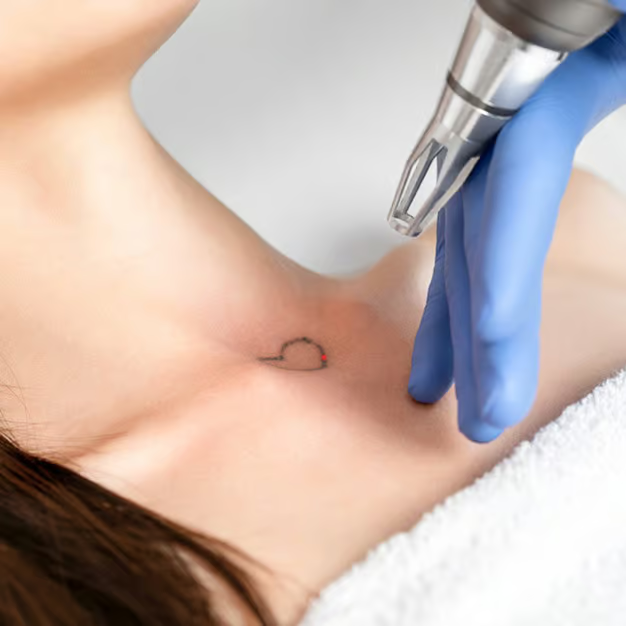
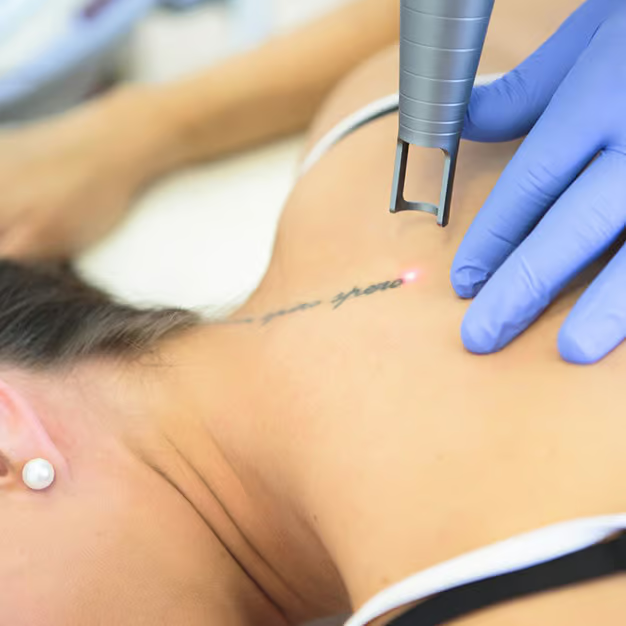
Tattoo removal aims to remove the pigments in the skin using a laser. When a beam of light is directed at the tattoo, it is drawn directly to the coloured pigment in the skin. When the laser comes into contact with the industrial pigment, a thermal reaction occurs and the pigment is burnt. The tattoo instantly turns white, a sign that swelling is occurring. This subsides a few days later and the tattoo reappears, but more faded.
Several sessions are needed before achieving a conclusive result: around 6 to 10 sessions on average. For tattoos larger than 30 centimetres, more sessions will be required.
The different types of tattoo removal lasers
The Nd:Yag laser
The Nd:Yag laser is suitable for tattoo removal, but also for treating spider veins and fine lines under the eyes. It is effective on all skin phototypes. This laser emits infrared light at a wavelength of around 1064 nanometres. It can be used in continuous or pulsed mode. It significantly removes ink in a single pass over the skin.
This laser only acts on the areas treated by the doctor and does not damage the other components of the skin. During a tattoo removal session, the Nd:Yag laser targets only the coloured pigments located under the skin. This Yag laser is not aggressive: the patient feels a slight tingling for a few hours after the session, similar to sunburn.
Removing a tattoo requires several sessions (depending on the ink colour and the size of the tattoo), spaced 6 to 8 weeks apart on average.
The Q-Switched laser
The Q-Switched laser is a tattoo removal laser specially designed for fair skin. Unfortunately, it is not effective on olive or dark skin. It is one of the best solutions for removing an amateur or professional tattoo. This laser treatment is also used to remove pigmentation spots.
Sessions with this laser are quick: they last only a few minutes, as the laser reaches the ink and shatters it in a few nanoseconds. However, the length of the session varies with the size of the tattoo to be removed.
The tattoo disappears in 4 to 6 sessions on average, depending on the depth of the ink. You need to wait 6 to 8 weeks between Q-Switched laser removal sessions.
The Q-Switched Ruby laser
This picosecond laser works on a wider range of inks than the classic Q-Switched laser. It is the most effective tattoo removal laser on blue or green inks. It has a high pulse energy, capable of breaking down almost all ink molecules, whatever the colour of the tattoo.
Allow around 4 to 8 sessions to completely remove a tattoo with this laser treatment, depending on the depth of the tattoo. Sessions must also be spaced 6 to 8 weeks apart with this type of laser.
The Discovery Pico laser
Pico lasers (such as Picoway or Picosure) have a high peak power, which allows them to deliver powerful energy in a very short time.
This multifunctional laser is suitable for tattoo removal as well as for treating scars, vascular lesions and brown spots. Very powerful, it removes both black and coloured tattoos. It is the best laser for treating tattoos that are difficult to remove. It works with short pulses and is very precise.
Does laser tattoo removal hurt?
Without local anaesthesia, laser tattoo removal can be painful. However, it is no more painful than getting a tattoo.
Our doctors can prescribe an anaesthetic cream during the consultation before the procedure. This cream should be applied 1 hour 30 minutes to 2 hours before the session to numb the area. Laser tattoo removal then becomes painless. The patient may feel some tingling during the session, but nothing more.
How do you prepare for a tattoo removal session?
The first session to erase a tattoo is preceded by a consultation with the practitioner. This is a mandatory step in the treatment protocol. The consultation makes it possible to estimate the number of sessions and the cost of the removal. The doctor also checks the patient’s medical history and asks questions to make sure the removal is feasible. An anaesthetic cream may be prescribed to limit pain during the removal.
What happens after a tattoo removal session?
After a laser tattoo removal session, the patient must apply an antiseptic or rich ointment (such as petroleum jelly) to the tattoo three times a day. This keeps the skin hydrated and helps it heal well. Blisters may appear on some areas after the session; it is very important not to pop them. The practitioner applies a dressing to the tattoo, to be kept on until the next day. The tattoo should then be left uncovered, unless the patient is exposed to the sun: the area must be kept out of UV rays until it has healed.