Quality charter
Hygiene: your safety, our priority
The French decree of 11 March 2009 sets out the general rules of hygiene and safety for tattooing techniques that break the skin, including permanent makeup. Naturacil works in close collaboration with a medical laboratory. If you have allergies or are undergoing medical treatment, you must inform us and bring medical approval.
A suitable environment
Tattooing techniques are carried out in well-ventilated premises. These include a treatment room used exclusively for tattooing, which has the following two features:
- floors and work surfaces made of smooth, non-porous materials that withstand repeated use of disinfectant and cleaning products;
- washable, non-textile surfaces.
A hand-washing area is located within or next to the treatment room. It includes at least a sink with an automatic or mechanical, hands-free tap, a liquid soap dispenser and a single-use towel dispenser.
The premises also include the following two separate spaces:
- a room dedicated to cleaning and sterilising equipment: this room has the same features as the treatment room and is divided into two separate zones, one for cleaning and disinfecting equipment and one for packaging and sterilisation;
- a room dedicated to storing waste and used linen.
The furniture used in the treatment room and in the cleaning and sterilisation area is non-porous and easy to clean. The upholstery of the furniture on which the client is seated is washable. Animals are not allowed in the treatment room or in the cleaning and sterilisation room. The premises are maintained so as to guarantee hygienic practices.
Cleaning the premises
The treatment room and the cleaning room are cleaned daily by wet bio-cleaning decontamination:
- either in one step, with a detergent-disinfectant for floors, surfaces and furniture bearing the NF EN 1040 and NF EN 1275 standards;
- or in three steps, by successively applying a commercial detergent, rinsing, then a disinfectant bearing the same standards.
The furniture in the treatment room is wiped at least once a day with a single-use, lint-free cloth impregnated with detergent-disinfectant.
Between clients, all surfaces used are cleaned and disinfected. In addition, in the event of biological soiling in the treatment room, the room and its furniture are cleaned immediately with a single-use, lint-free cloth impregnated with a detergent-disinfectant.
Hand hygiene and gloves
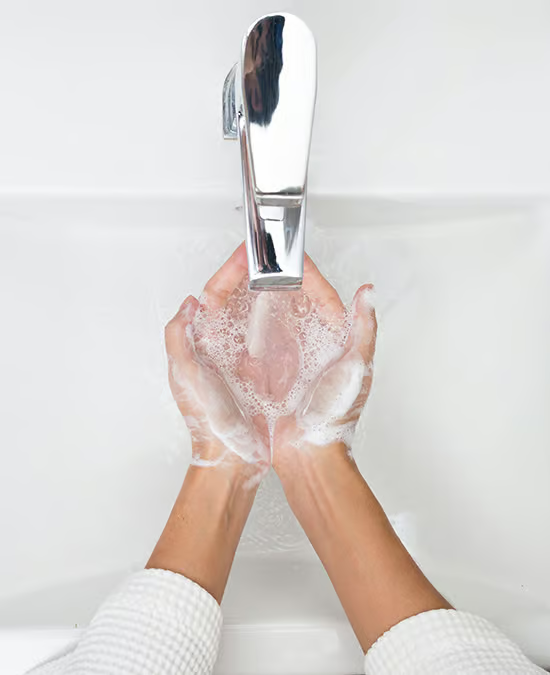
The practitioner follows the hand hygiene procedure. All jewellery is removed before hand disinfection. The practitioner’s hands are disinfected:
- either by hygienic hand washing with an antiseptic liquid soap or antiseptic foaming solution bearing the NF EN 1040 and NF EN 1499 standards, following the standardised hand-washing procedure described in Annex A of standard NF EN 1499;
- or by hygienic hand rubbing with an alcohol-based product bearing the NF EN 1040, NF EN 1275 and NF EN 1500 standards, following the standardised hand-rubbing procedure described in Annex A of standard NF EN 1500.
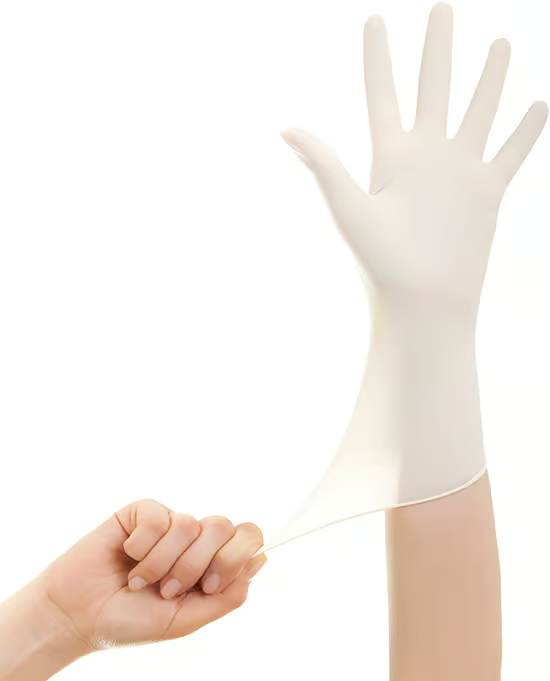
After disinfecting their hands and before performing the procedure, the practitioner puts on single-use gloves. The gloves are powder-free latex, or an equivalent material in case of latex allergy. They are CE-marked and classified as class II (a) medical devices for sterile gloves and class I for non-sterile gloves. Gloves are changed between clients and at least every two hours during the same procedure. They are removed whenever the practitioner needs to touch any object unrelated to the tattooing. Before resuming the procedure, a new pair of gloves is used after hand disinfection.
Skin preparation
The practitioner prepares the area to be tattooed according to a specific protocol. The skin or mucous membrane to be tattooed, clean and free of lesions, is prepared following this four-step protocol:
- 1. Cleansing with an antiseptic liquid soap or antiseptic foaming solution from the same family as the antiseptic used in step 4;
- 2. Rinsing;
- 3. Drying;
- 4. Skin antisepsis with two successive applications of an antiseptic meeting the NF EN 1040 and NF EN 1275 standards; between the two applications and after the second, the antiseptic contact times specified by the manufacturer are respected, at least until completely dry. Any hair removal on the area is carried out with a single-use blade immediately before the procedure.
Equipment and inks
The practitioner uses equipment that ensures the client’s safety by limiting allergic and infectious risks. At each session, for each client, the needles that break the skin barrier are sterile and single-use. Other equipment connected to these devices that does not come into contact with the client’s skin or mucous membranes is cleaned with a disinfectant bearing the NF EN 1040, NF EN 1275 and NF T72-180 standards. This cleaning is carried out daily and after any soiling by biological matter.
The inks used comply with current regulations and are used according to the manufacturers’ recommendations. Inks are diluted with water for injection. The treatment chair or bed is covered with single-use protection changed after each client.
The practitioner performs the tattoo following specific hygiene rules. The work table is prepared before the procedure: it is covered with a single-use drape on which the caps, tattoo ink and rinsing water, prepared in advance, are placed. When filling the caps, the spout of the ink bottle must never touch the cap or any ink already poured into it. If petroleum jelly is used, it is taken from its original container with a single-use applicator.
Immediately after the procedure, the needle holders are immersed in a pre-disinfection tray in accordance with the “Sterilisation protocol” annex. Waste classified as infectious healthcare waste (notably needles and gloves) is disposed of in accordance with the applicable regulations.